Why SingleStore is the ideal choice for real-time analytics
Most of the difficulty around Time analytics comes from missing the basics, not from a lack of options.
A good data experience is the key to winning or losing a customer. Today’s evolved and aware users seek real-time insights and analytics to make quick decisions. That creates the need for solid data infrastructure to support ever-changing business needs.
Enter SingleStore, the world’s fastest distributed SQL database for real-time analytical applications. It combines transactional and analytical workloads within a multi-model structure in a single engine.
Several case studies prove its success–many of which were highlighted at the Leaders Exchange: Indian Startups’ AI Journey to Global Dominance, organised by SingleStore in collaboration with YourStory.
Apart from the keynote address by Sanjay Arora, General Manager, APAC, SingleStore, the event included a fireside chat–Raj Verma, CEO, SingleStore, and Shradha Sharma, Founder and CEO, YourStory.
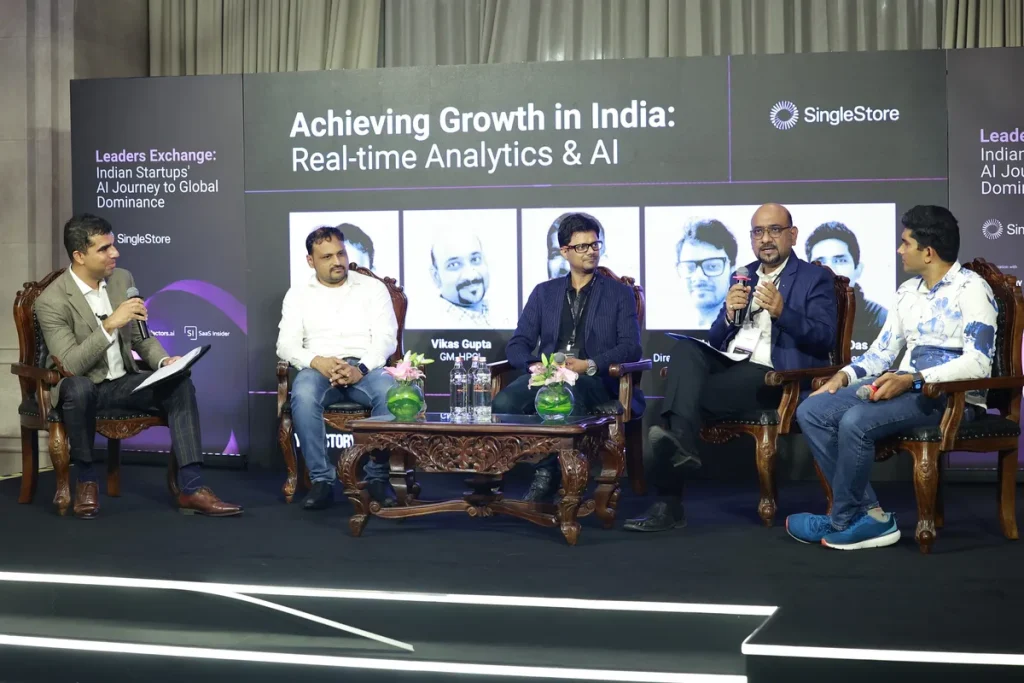
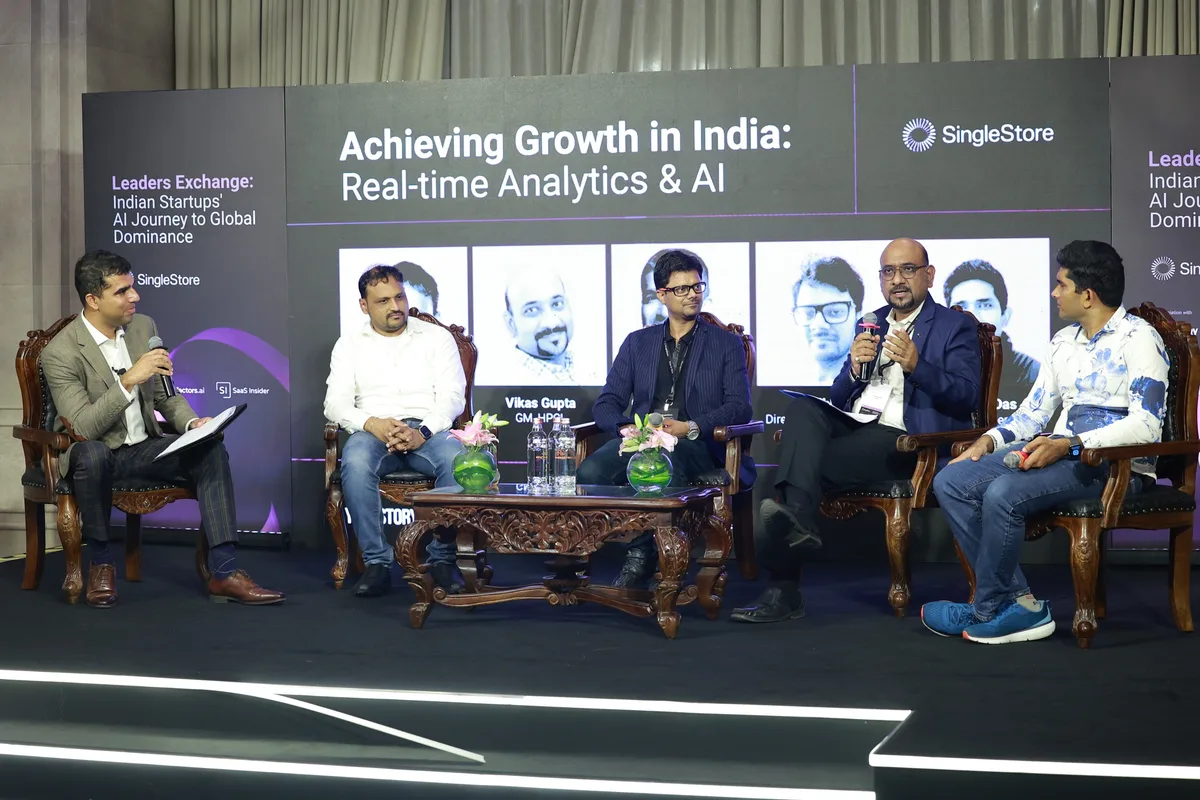
A panel discussion on ‘Achieving Growth in India: Real time analytics and AI’ brought together trailblazers like Praveen Das, Co-founder, factors.ai; Vikas Gupta, General Manager, HPCL; Vaibhav, Director of Engineering,BharatPe; and Sreedhar Gade, Vice President of Engineering, Freshworks. They discussed the unparalleled opportunities for Indian startups to achieve global dominance through the power of real-time AI. The session was moderated by George Kuruvilla, Senior Director, Data Platform Evangelist (APAC), SingleStore.
Leveraging real-time analytics for growth and decision-making
Elaborating on factors.ai’s journey, Das shared that the first year was all about building the product and getting a few customers on board. However, in 2021, they signed up with SingleStore, because their app was “horribly slow” and impacted customers.
“We did a few evaluations and had certain criteria like being cloud-neutral. We were looking for a single database for both analytical and transactional workloads. As a company, analytics is the core offering of our product,” he shared, adding that factors.ai has scaled from an S2 cluster to S12 cluster in the last three years.
The company has managed its growth without any single resource dedicated to infrastructure. “That’s the sort of advantage we have…our focus has purely been on the application,” Das said.
Gupta spoke about the varied challenges in operations and decision-making in the oil industry. HPCL has a platform, HP Udgam, to support startups and provide funding to those with a vision to grow the industry. But everything boils down to the value driven from data.
“Our products are commodity-based so we need to know how to deliver value to the customer. It is all about how one can offer a personalised experience to the customer. We have moved from ‘data is the new oil’ to ‘data is the daata (giver)’. If you want to earn your bread, you have to play with data,” he shared.
To manage operations, Gupta said it is important to put a governance layer on an OT platform to tell you what is right and what needs to be invested. “Safety is paramount for the oil and gas sector. We have been able to establish visual analytics at our retail outlets to enhance customer safety and avert untoward incidents,” he said, adding that the improved customer service is a consequence of the SingleStore collaboration.
Innovation for scaling
BharatPe reported a 77% surge in new merchant signups in February 2024. But how did the company navigate such large volumes? “It’s more about readiness regarding such scenarios. It can only be done through data infrastructure that we prepare and the data platform we choose. One obvious keyword that comes to everyone’s mind is auto scaling but it also has its limitations, “ he said. He added that handling such scenarios necessitates the implementation of multiple machine learning algorithms in the background, based on data collected in the past.
Freshworks, which started as a single product company in 2010, added multiple products and went public over time. Today, it has a presence in 100+ countries, with 65,000 customers across industry verticals.
“We have been innovating on GenAI and trying to stay ahead of the curve. We have Freshdesk, our customer experience product. We also have Freshservice and, on top of it, when you have Gen AI, you are talking about predictive analytics. Everyone is playing in the past or present; we are playing in the future,” Gade said.
Freshworks is looking to revolutionise customer experience through agentic actions. “We recently launched a beta version of self-service on our CX product where 100% of agent actions are taken by the AI, both on voice or text. This is just the beginning of things that are to come,” Gade said.

If Time analytics feels overwhelming, start with the smallest step that produces a visible result. Anyone weighing Time analytics should compare at least two realistic options before deciding. In practice, Time analytics works best when the basics are handled before anything else. A quick note on Time analytics: the follow-up matters as much as the first decision.

Related reading
For background context, see WeddingWire.
A simple step-by-step approach
Start with the basics of Time analytics and keep the first step small enough to finish in one sitting. Gather the information you need, compare two or three realistic options, and note the trade-offs in plain language rather than marketing terms.
Then test the decision on a small scale before you scale it up. This is the part most people skip, and it is the reason Time analytics sometimes feels harder than it should. A short trial tells you more than another hour of reading, and it usually surfaces the one constraint that matters in your case.
Mistakes that cost time and money
The most common mistake with Time analytics is treating the first option you find as the only option. Comparison is not busywork: differences in scope, support, and timing often matter more than the headline number.
The second mistake is ignoring the follow-up. Whatever you choose, plan how you will check that it worked. A quick review after two weeks catches problems while they are still cheap to fix, and it turns Time analytics from a one-time decision into something you can improve.
What to check before you start
Before committing time or money to Time analytics, it helps to know what a good outcome looks like. Write down the result you actually need, the budget you can live with, and the deadline you are working against. Those three answers rule out most of the options that look attractive but do not fit your situation.
Next, look at the details that are easy to miss: what is included, what costs extra, and what happens when something goes wrong. Ask directly about timelines and follow-up. A clear answer is usually a better sign than a low price, because Time analytics is rarely a one-off purchase of attention.

Daniel Harris covers wedding planning since 2020, testing 70+ venues, vendors, and checklists on cost, quality, and reliability to help couples choose with confidence.